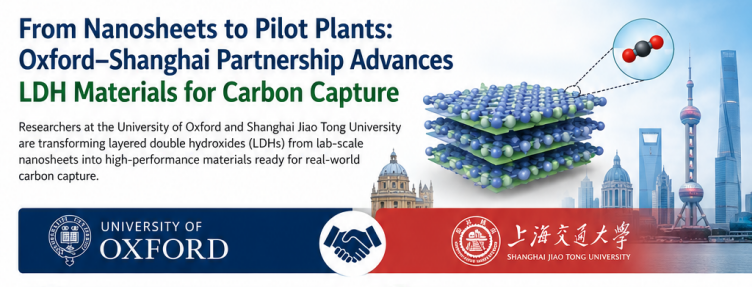
从纳米片设计到吨级中试,上海交通大学联合牛津大学推动二氧化碳捕集技术走出实验室、落地工程场景。牛津大学Dermot O’Hare 教授团队与我校朱炫灿副教授团队,在王如竹教授等支持下,围绕层状双金属氢氧化物(LDHs)持续开展材料设计、规模化制备、吸附剂成型及系统集成研究,已实现单批50千克材料生产、50 Nm3/h双塔实验平台和吨级直接空气捕集中试验证。相关技术兼具高效吸附、低温再生与规模化应用潜力,可服务于工业烟气减排、直接空气捕集及建筑室内空气管理。目前,双方正联合产业伙伴推进真实工况测试与示范应用,加快形成贯通基础研究、工程放大和商业转化的国际合作创新链,为“双碳”目标下的低能耗碳捕集提供新路径。
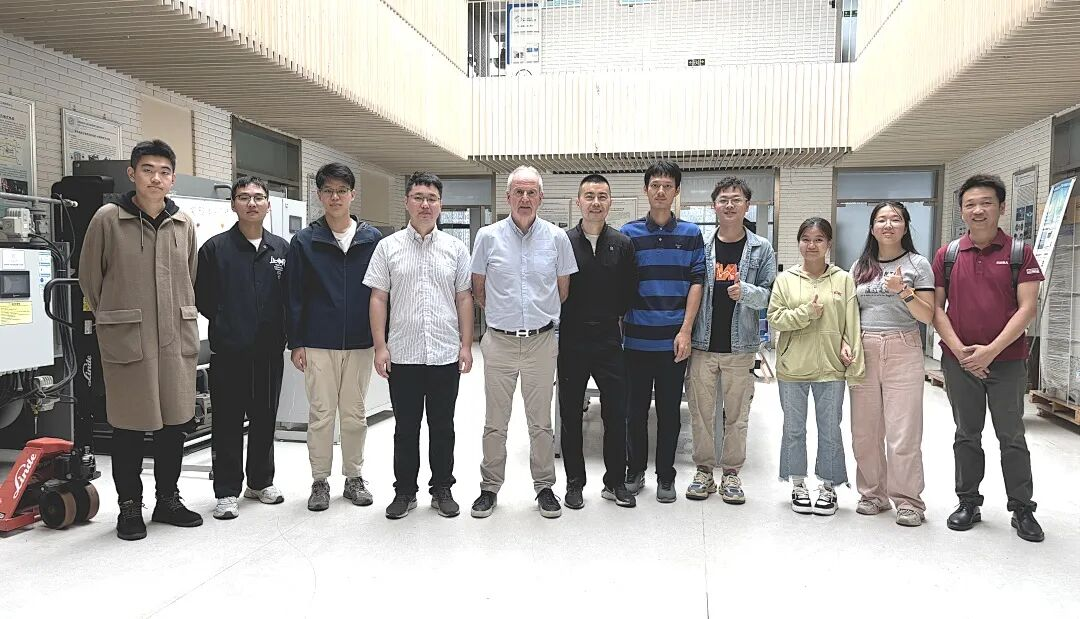
2024年Dermot O’Hare教授(左五)和朱炫灿副教授(左四)团队在中意楼合影
合作专家简介
Dermot O'Hare(德莫特·奥黑尔)教授是国际知名的无机化学与材料化学家,现任牛津大学有机金属与材料化学教授、牛津大学贝利奥尔学院化学高级研究员,并担任SCG–牛津卓越研究中心主任。他长期从事层状双金属氢氧化物(LDHs)、功能纳米材料、催化与聚合物等领域研究,致力于以材料创新应对二氧化碳管理、能源转型、绿色化学和循环经济等重大挑战;其团队开发的高比表面积LDH及水混溶有机溶剂处理技术,为LDH材料在碳捕集、催化和可持续包装等领域的规模化应用奠定了重要基础。O'Hare教授尤其重视基础研究与产业需求的结合,2012年推动创建SCG–牛津卓越研究中心,构建了长期稳定的产学研合作平台,相关合作已形成一批专利、论文及产业化成果,并于2019年获得英国皇家化学会“产学合作奖”。凭借在材料化学、催化和纳米材料领域的原创贡献及其对可持续技术应用与商业转化的推动,他先后获得英国皇家化学会Ludwig Mond奖、Tilden奖,并于2024年获John B. Goodenough材料化学奖。
打开层间空间,捕集更多二氧化碳
水相互溶有机溶剂处理技术(aqueous miscible organic solvent treatment,AMOST)是支撑双方合作的一项核心科学突破。传统LDH颗粒通常堆叠紧密,导致大量内部表面被遮蔽,并限制气体分子的传输。AMOST技术利用有机溶剂置换LDH层间的水,使纳米片相互分离,形成开放的花状结构,从而显著增大材料的比表面积,并形成更多可利用的孔道。
牛津大学—上海交通大学联合团队证明,剥离后的LDH能够更加高效地负载活性组分。在较高温度下,钾改性LDH衍生材料的二氧化碳工作容量显著高于传统商业材料。深入的实验研究还揭示了钾助剂与镁铝比例如何协同作用,形成不同类型的吸附位点。这些发现为面向工业气体处理、燃烧前碳捕集和氢气纯化的材料设计提供了科学依据。
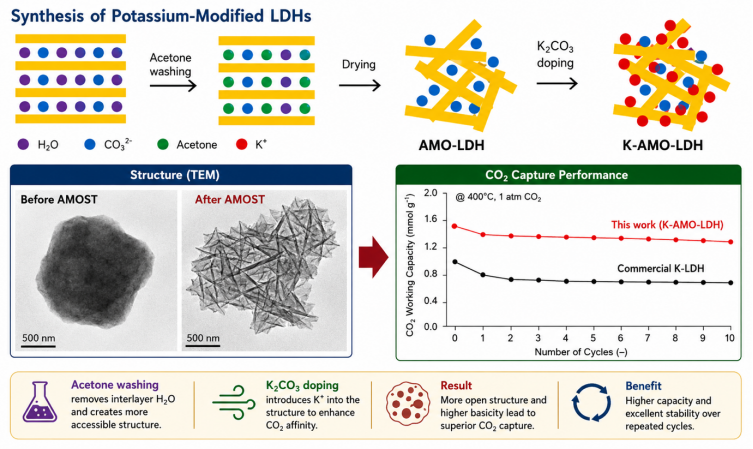
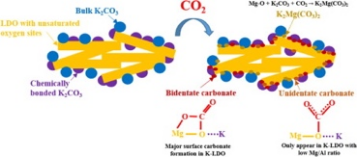
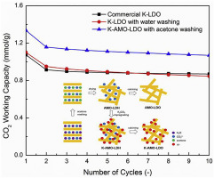
图1. 打开LDH纳米片,实现中温二氧化碳捕集。 水相互溶有机溶剂处理技术可将堆叠的LDH层分离,形成开放的花状颗粒;随后通过钾改性引入更多活性位点,使材料在400℃下获得高于传统商业钾改性LDH的二氧化碳工作容量。
从空气中捕集二氧化碳
此后,双方进一步将LDH材料平台由高温工业气体分离拓展至低浓度二氧化碳捕集。通过在LDH纳米片及其氧化物衍生材料上负载胺类物质或进行化学接枝,研究人员开发出能够选择性结合二氧化碳的材料,即使在二氧化碳浓度仅为百万分之四百(400 ppm)的环境空气中仍可有效工作。
其中,一种胺浸渍LDH衍生材料在模拟空气条件下的二氧化碳吸附容量达到每克2.27毫摩尔。另一种胺接枝LDH材料的吸附容量达到每克1.05毫摩尔,并可在30分钟内达到饱和吸附容量的70%;经过多次吸附—脱附循环后,其性能几乎没有衰减。近期研究还进一步提高了材料的胺负载量、低温再生性能、抗氧化稳定性以及湿度条件下的工作性能。这些进展使该类材料不仅适用于直接空气捕集,也适用于室内空气管理;对于后者而言,安全运行以及在70℃以下实现再生尤为重要。
双方合作也推动了国际社会对直接空气捕集技术的整体认识。合作团队在《Chemical Society Reviews》发表综述,系统总结了吸附剂设计、材料成型、吸附机理、过程工程、能源集成和技术经济分析等方面的研究进展,为推动实验室材料走向实际应用提供了路线图。
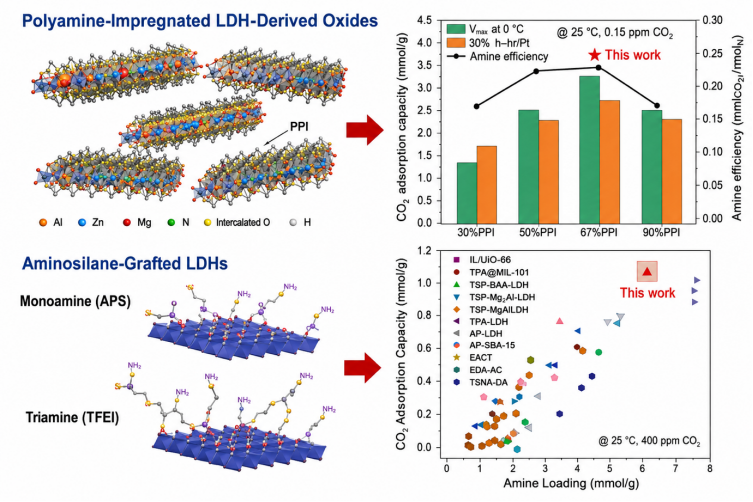
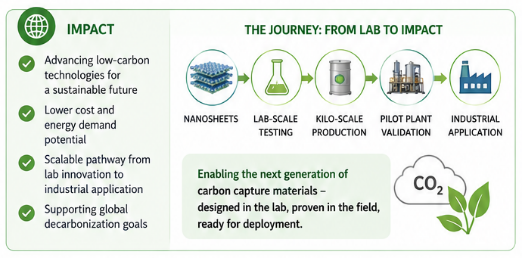
图2. 用于低浓度二氧化碳捕集和直接空气捕集的功能化LDH。 目前已开发出两类材料:一类是具有较高二氧化碳吸附容量的多胺浸渍LDH衍生复合金属氧化物;另一类是具有吸附速率快、再生温度低和循环稳定性强等特点的氨基硅烷接枝LDH纳米片。这些材料可在从工业烟气到二氧化碳浓度仅为400 ppm的环境空气等不同条件下运行。
设计完整的碳捕集工艺
高性能粉末材料只是开发实用碳捕集技术的起点。在实际过程中,大体积气流需要以尽可能低的阻力通过吸附装置,同时还必须在吸附和再生过程中实现热量与二氧化碳的快速传递。因此,双方合作将牛津大学在先进材料化学方面的专长,与上海交通大学在吸附过程、热力系统、结构化接触器和中试工程方面的优势结合起来。
上海交通大学团队开发了蒸汽辅助变温真空吸附技术(steam-assisted temperature–vacuum swing adsorption,S-TVSA)。在这一过程中,低压蒸汽用于加热吸附剂,并促进高浓度二氧化碳的释放。该工艺可利用低品位工业余热、太阳能热能或热泵驱动,为降低再生能耗提供了可行路径。过程模拟研究还确定了能够兼顾二氧化碳纯度、生产效率和能源消耗的运行条件。
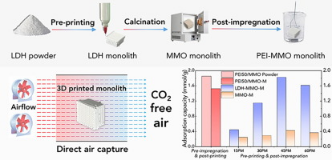
研究人员还利用三维打印技术,将LDH衍生吸附剂制备成适用于气—固接触器的开放式整体结构。这些结构中活性吸附剂的质量占比超过90%,同时具有低阻力气流通道。在直接空气捕集条件下,经过优化的整体式吸附剂对二氧化碳的吸附容量达到每克1.82毫摩尔,并表现出良好的吸附动力学性能和循环稳定性。
从实验室合成走向中试示范
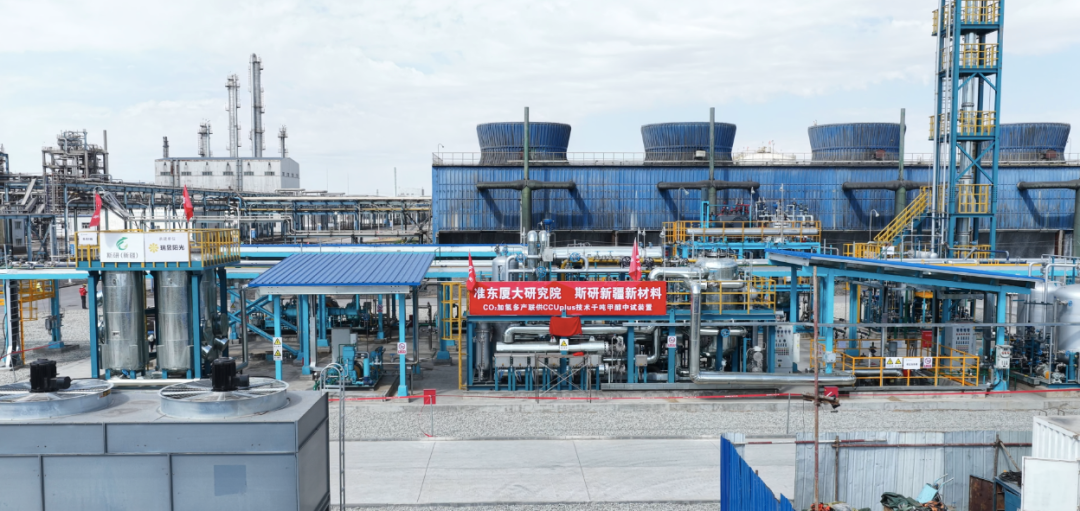
该合作项目沿着从科学发现到工程应用的路径持续推进。2019年,团队展示了高性能功能化LDH吸附剂;2021年,围绕结构化二氧化碳吸附剂开展了专利布局;2023年,研究人员建成了一套采用蒸汽吹扫的双塔台架系统,气体处理能力达到每小时50标准立方米(50 Nm3/h)。到2025年,材料合成规模已扩大至单批50千克,同时保留了高效二氧化碳捕集所需的纳米片形貌、比表面积和孔隙结构。2026年,S-TVSA技术进一步进入吨级直接空气捕集中试阶段。
50千克级生产工艺采用更安全的工业原料和成本更低的溶剂替代实验室工艺,并提供了溶剂回收方案。经过优化后,吸附剂材料的预计生产成本可降低至每千克16.7美元。更为重要的是,放大生产后的材料仍能保持实验室样品所具有的开放纳米片结构和二氧化碳吸附性能,证明其基础化学合成方法可有效转化至更大的生产规模。
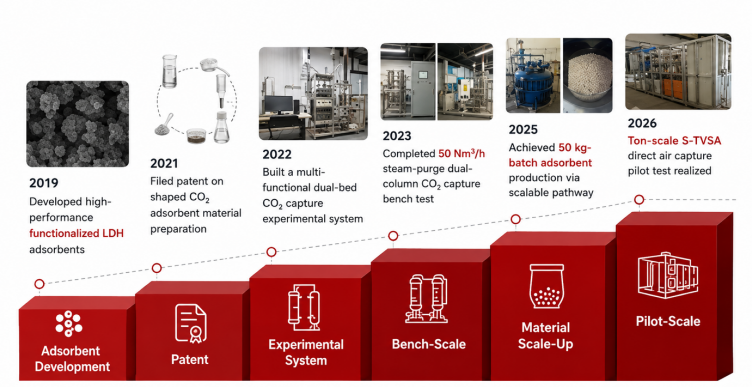
图3. 从实验室发现到中试规模示范的发展历程。 牛津大学—上海交通大学合作团队已实现从吸附剂开发和专利布局,到每小时50标准立方米双塔台架系统、单批50千克材料生产,以及吨级S-TVSA直接空气捕集中试的持续推进。
迈向商业化应用
下一阶段,合作团队将重点在真实运行条件下对原型系统进行验证,考察氧气、水分、温度波动以及长期吸附—脱附循环等因素的影响。潜在应用包括工业烟气二氧化碳捕集、直接空气捕集、室内及建筑空气管理,以及为二氧化碳封存或利用提供高浓度二氧化碳。
上海交通大学团队已通过公开招标入选一项拟投资350万元人民币的项目,计划开发基于LDH的测试平台,目标是每年从垃圾焚烧烟气中捕集20吨二氧化碳。团队也正在与工业合作伙伴开展洽谈,探讨将可低温再生的LDH材料用于控制建筑物和空调系统中的二氧化碳浓度。
在牛津大学,O’Hare教授团队正在探索包括LDH在内的高孔隙率镁基材料的商业化供应。上海交通大学则可在吸附剂评价、材料成型、热力循环设计、系统集成和中试示范等方面为相关工作提供支持。通过将牛津大学在先进材料化学领域的专长与上海交通大学在吸附工程和规模化放大方面的能力相结合,双方合作的目标不仅是获得性能更优的实验室粉末材料,更是开发能够在真实碳捕集条件下可靠运行的材料、装置和工艺。
双方已共同建立起一条完整的创新路径,覆盖纳米尺度材料设计、机理研究、千克级生产、结构化吸附装置和中试系统。该双边合作充分表明,基础化学与工程技术的协同创新能够加快碳捕集技术从学术研究走向实际应用和商业化部署。
英文完整版
From Nanosheets to Pilot Plants: Oxford–Shanghai Partnership Advances LDH Materials for Carbon Capture
This long-standing collaboration between the University of Oxford and Shanghai Jiao Tong University is translating fundamental materials chemistry into scalable technologies for capturing carbon dioxide from industrial gases, indoor air, and the atmosphere.
Researchers led by Professor Dermot O’Hare at the University of Oxford and Associate Professor Xuancan Zhu at Shanghai Jiao Tong University (SJTU), working with colleagues including Professor Ruzhu Wang, have developed a collaborative programme to meet these challenges using layered double hydroxides (LDHs). These low-cost and highly adaptable materials are composed of stacked, positively charged nanosheets whose composition and surface properties can be tailored for different carbon-capture applications.
Carbon capture is essential for reducing emissions from industry and addressing carbon dioxide already present in the atmosphere. Yet many established capture processes rely on corrosive liquid solvents and require substantial energy for regeneration. Solid adsorbents offer a promising alternative, but they must combine high capacity, rapid uptake, long service life, low-temperature regeneration, and affordable large-scale production.
Opening the layers to capture more CO2
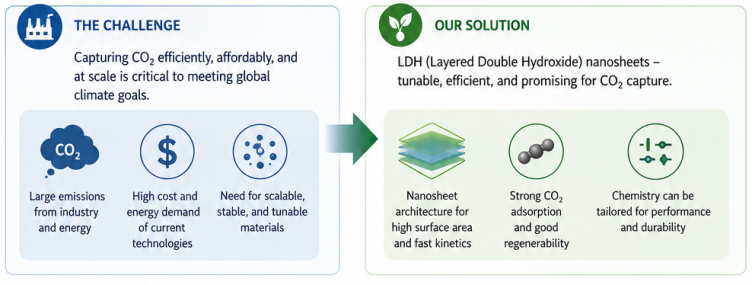
A central scientific advance underpinning the collaboration is Oxford’s aqueous miscible organic solvent treatment, known as AMOST. Conventional LDH particles tend to stack tightly, hiding much of their internal surface and restricting the movement of gas molecules. AMOST replaces water between the layers with an organic solvent, allowing the sheets to separate and form open, flower-like structures with much larger surface areas and more accessible pores.
The Oxford–SJTU team demonstrated that these exfoliated LDHs can host active components much more effectively. At elevated temperatures, potassium-modified LDH-derived materials achieved substantially higher CO2 working capacities than conventional commercial materials. Detailed experimental studies also revealed how potassium promoters and the Mg:Al ratio work together to create different adsorption sites. These findings provide a scientific basis for designing materials for industrial gas treatment, pre-combustion carbon capture, and hydrogen purification.
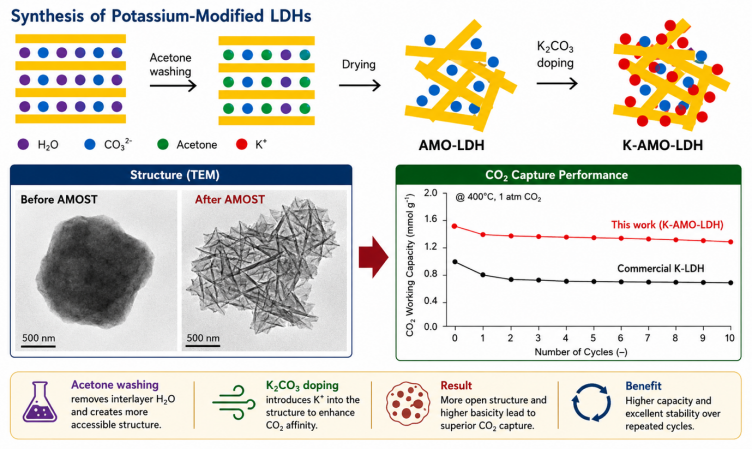
Figure 1. Opening LDH nanosheets for elevated-temperature CO2 capture. Aqueous miscible organic solvent treatment separates stacked LDH layers and creates open, flower-like particles. Potassium modification then introduces additional active sites, producing higher CO2 working capacities than conventional commercial potassium-modified LDHs at 400 °C.
Capturing CO2 from air
The collaboration subsequently extended the LDH platform from high-temperature industrial separation to low-concentration CO₂ capture. By loading or chemically grafting amines onto LDH nanosheets and their oxide derivatives, the researchers developed materials capable of selectively binding CO2 even at the 400 parts per million found in ambient air.
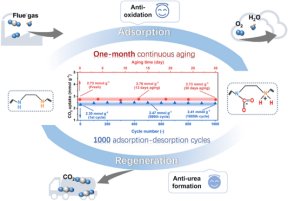
One amine-impregnated LDH-derived material captured 2.27 mmol of CO2 per gram under simulated air conditions. A complementary amine-grafted LDH achieved 1.05 mmol per gram, reached 70% of its full capacity within 30 minutes and showed negligible performance degradation during repeated adsorption–desorption cycles. More recent studies have further improved amine loading, low-temperature regeneration, oxidative stability, and performance under humid conditions. These developments make the materials relevant not only to direct air capture but also to indoor air management, where safe operation and regeneration below 70 °C are particularly important.
The partnership has also contributed to the wider international understanding of direct air capture. A joint review published in Chemical Society Reviews brought together developments in adsorbent design, material shaping, adsorption mechanisms, process engineering, energy integration, and techno-economic analysis, providing a roadmap for translating laboratory materials into practical systems.
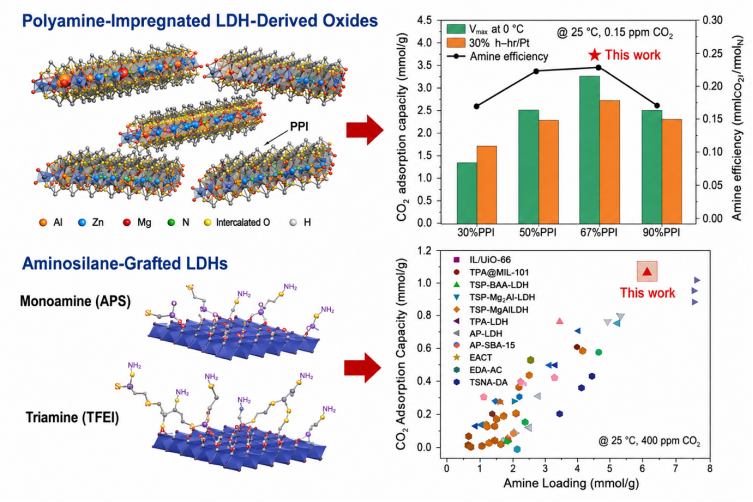
Figure 2. Functionalised LDHs for low-concentration and direct air capture. Two material families have been developed: Polyamine-impregnated LDH-derived mixed-metal oxides with high CO2 capacities, and aminosilane-grafted LDH nanosheets with rapid uptake, low-temperature regeneration, and strong cycling stability. The materials operate under conditions ranging from industrial flue gas to ambient air containing 400 ppm CO2.
Designing the complete capture process
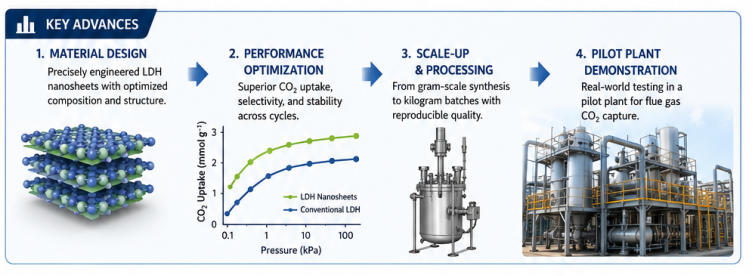
A high-performing powder is only the starting point for a practical carbon-capture technology. Large volumes of gas must pass through an adsorber with minimal resistance, while heat and CO2 must move rapidly during adsorption and regeneration. The collaboration therefore connects Oxford’s expertise in advanced materials chemistry with SJTU’s strengths in adsorption processes, thermal systems, structured contactors, and pilot-scale engineering.
The SJTU team developed steam-assisted temperature–vacuum swing adsorption, or S-TVSA, in which low-pressure steam heats the adsorbent and helps release concentrated CO2. Because the process can be driven by low-grade industrial waste heat, solar heat, or heat pumps, it provides a route towards lower-energy regeneration. Process modelling has also identified operating conditions that balance CO2 purity, productivity, and energy consumption.
The researchers have additionally used three-dimensional printing to shape LDH-derived adsorbents into open monoliths suitable for gas–solid contactors. These structures contain more than 90% active adsorbent while providing low-resistance channels for air flow. Under direct-air-capture conditions, an optimised monolith achieved a CO2 uptake of 1.82 mmol per gram, together with good adsorption kinetics and cycling stability.
From laboratory synthesis to pilot demonstration
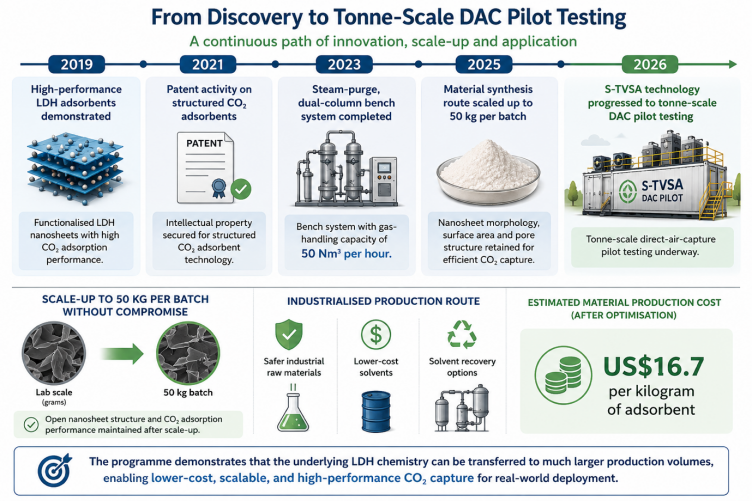
The programme has successfully progressed from laboratory research to industrial-scale application. Key milestones include high-performance LDH adsorbents in 2019, patented structured CO₂ adsorbents in 2021, a 50 Nm³/h dual-column bench system in 2023, and scale-up of adsorbent production to 50 kg per batch by 2025, followed by tonne-scale direct-air-capture pilot testing in 2026.
Crucially, scaling up production has not compromised the material’s structure or CO₂ capture performance. The industrialised process also uses safer raw materials, cheaper solvents, and solvent-recovery options, with an estimated optimised production cost of US$16.7/kg. Overall, the work demonstrates that the adsorbent technology is technically scalable and has a credible pathway toward lower-cost commercial production.
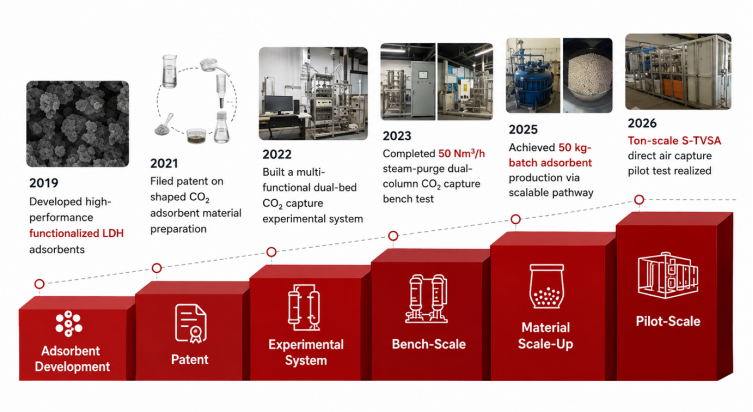
Figure 3. The journey from laboratory discovery to pilot-scale demonstration. The Oxford–SJTU collaboration has advanced from adsorbent development and patenting to a 50 Nm3 h−1 dual-column bench system, 50 kg-batch material production, and tonne-scale S-TVSA direct-air-capture pilot testing.
Towards commercial deployment
The next phase of the collaboration will focus on validating prototypes under realistic operating conditions, including oxygen, moisture, temperature fluctuations, and extended adsorption–desorption cycling. Potential applications include CO2 capture from industrial flue gas, direct air capture, indoor, and building air management, and the supply of concentrated CO2 for storage or utilisation.
· The Oxford–SJTU collaboration is moving towards the commercial deployment of LDH-based CO₂ capture technologies. The next stage will test materials under realistic conditions and explore applications including industrial flue-gas capture, direct air capture, building air management, and CO₂ supply for storage or utilisation.
· SJTU has been selected for a proposed RMB 3.5 million project to develop a testbed capable of capturing 20 tonnes of CO₂ per year from waste-incineration flue gas, while further industrial applications are being discussed. Oxford contributes expertise in advanced porous materials and potential commercial production, while SJTU provides capabilities in testing, system design, scale-up, and pilot demonstrations.
· Overall, the partnership creates a pathway from laboratory material development to kilogram-scale production and real-world pilot systems, combining chemistry and engineering to accelerate practical and commercial carbon-capture solutions.
Selected joint publications
1. Roles for K2CO3 doping on elevated temperature CO2 adsorption of potassium promoted layered double oxides, X. Zhu, C. Chen, Q. Wang, Y.Shi, D. O'Hare, and N.Cai, Chem. Eng. J., (2019), 366, 181-191.
DOI Link:
2. Synthesis of elevated temperature CO2 adsorbents from aqueous miscible organic-layered double hydroxides, X. Zhu, C. Chen, H. Suo, Q. Wang, Y. Shi, and D. O'Hare, N. Cai, Energy, (2019), 167, 960-969.
https://doi.org/10.1016/j.energy.2018.11.009
3. Aqueous miscible organic-layered double hydroxides with improved CO2 adsorption, X. Zhu, Xuancan. C. Chen, Y. Shi, D. O'Hare, N. Cai, Adsorption (2020), 26, 1127-1135.
https://doi.org/10.1007/s10450-020-00209-4
4. Efficient CO2 capture from ambient air with Amine-functionalized Mg–Al mixed metal oxide nanosheets, X. Zhu, T. Ge, F. Yang, M. Lyu, C. Chen, D. O’Hare, R. Wang, J. Mater. Chem., A., (2020), 8, 16421-16428.
https://doi.org/10.1039/D0TA05079B
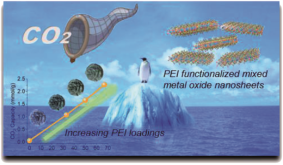
5. Modified Layered Double Hydroxides for Efficient and Reversible Carbon Dioxide Capture from Air, X. Zhu, M. Lyu, T. Ge, J. Wu, C. Chen, F. Yang, D. O’Hare, R. Wang, Cell Reports, Physical Science, (2021), 2, 100484.
https://doi.org/10.1016/j.xcrp.2021.100484
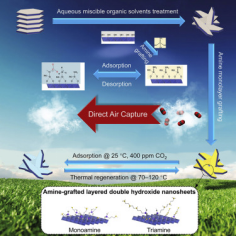
6. Recent advances in direct air capture by adsorption, X. Zhu, W. Xie, Wu, Y. Miao, X. Chen, B. Ge, Z. Gan, F. Yang, M. Zhang, D. O'Hare, J. Li, T. Ge, R. Wang, Chem. Soc., Rev., (2022), 51, 6574-6651.
https://doi.org/10.1039/D1CS00970B
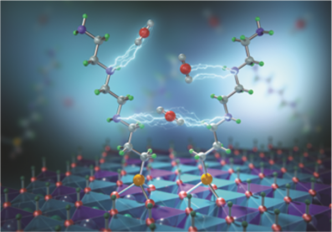
7. Scalable synthesis of amine-grafted ultrafine layered double hydroxide nanosheets with improved carbon dioxide capture capacity from air, B. Ge, C. Chen, Z. Gan, X. Zhu, Y. Miao, Y. Wang, T. Ge, D. O'Hare, R. Wang, ACS Sustainable Chem. Eng., (2023), 11, 9282 - 9287.
https://doi.org/10.1021/acssuschemeng.3c01183
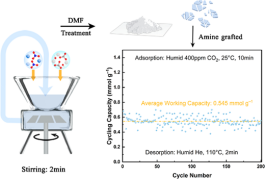
8. 3D printing of poly(ethyleneimine)-functionalized Mg-Al mixed metal oxide monoliths for direct air capture of CO2, Q. Shao, Z. Gan, B. Ge, X. Liu, C. Chen, D. O’Hare, X. Zhu, J. Energy Chem., (2024), 96, 491 - 500.
https://doi.org/10.1016/j.jechem.2024.05.015
9. Enhancing adsorbent performance for direct air capture of CO2 by in-situ amine-grafting of layered double hydroxides, B. Ge, C. Chen, Y. Xu, S. Roberts, M. Zhang, Q. Shao, D. O’Hare, X. Zhu, Chemical Engineering Journal, (2024), 500, 156782.
https://doi.org/10.1016/j.cej.2024.156782
10. Design of Ultra-Stable Solid Amine Adsorbents and Mechanisms of Hydroxyl Group-Dependent Deactivation for Reversible CO2 Capture from Flue Gas, M Zhao, L. Huang, Y. Gao, Z. Wang, S. Liang, X. Zhu, Q. Wang, H. He, and D. O'Hare, Nano-Micro Lett., (2025) 17, 170.
https://doi.org/10.1007/s40820-025-01664-w
11. Innovative Design of PEI-Modified AMO-Layered Double Hydroxide for Efficient and Stable Direct Air Capture of CO2, M. Zhao, L. Huang, Y. Gao, Z. Wang, X. Zhu, Q. Wang, D. O'Hare, Adv. Sci., (2025), 12, e07756.
https://doi.org/10.1002/advs.202507756
素材来源:上海交大制冷所